
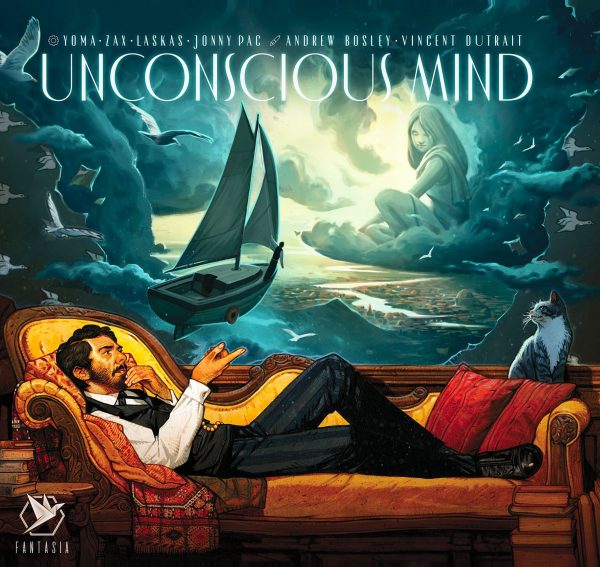
I played Unconscious Mind twice before writing this. Both times were with one other player (2p games).
Unconscious Mind is a medium‑to‑heavy eurogame with very little randomness beyond the shared tiles and cards available to all players. The game’s theme centers on treating and curing people receiving mental‑health care by gaining insights into how their dreams influence their emotional state. The theme helps players remember their goals and gives the game a fair table presence, but the core mechanisms could easily support a completely different setting—this could just as well have been a game about mining asteroids.
Players choose one of three actions on their turn: place an idea token on an empty space at the meeting table to take an action, treat patients using insight tokens, or retrieve all of their idea tokens and gain a bonus from the city map board.
When a player takes an action, they select an available space on the meeting table and immediately resolve its effect. A player may spend two idea tokens to take the same action twice, completing it once before repeating it. Actions include gaining notebook tiles, gaining or upgrading insights, moving around the city, or publishing treatises. Notebook tiles form an engine on the player board and trigger benefits when players take most actions. Insights act as the resources used to treat patients and must match the patient’s needs and dream cards. The city map allows players to move their token to different locations to claim bonuses during recall turns.
Treating a patient requires trading insights of the correct type and level to reduce their treatment requirement. As a patient approaches recovery, they reach a “catharsis” level, and the player removes the transparent grief layer covering the patient. Removing this layer reveals ongoing benefits to the player.
Recalling ideas simply means retrieving the idea tokens used on the meeting table. It has nothing to do with memory. When a player recalls their ideas, they also gain a bonus from the city map based on their current location. A Sigmund Freud token also moves around the map, and players can often use it as their stand‑in for movement and bonuses.
I’ve simplified the game a bit here, but this should provide enough context for the rest of the review. I left out some of the more detailed rules—especially those involving the map board—because they’re fiddly and hard to summarize without repeating large sections of the rulebook.
The game is fairly good. I enjoyed both of my plays. Although the game reduces the number of action spaces in a two‑player session, the number of patients treated and goals achieved stays the same. A four‑player game would probably take about the same amount of time, with only a slight increase as players work toward goals like “cure five patients.” A “round” counter doesn’t track rounds in the traditional sense; it advances whenever a player gains reputation. Most reputation comes from goals such as the one mentioned above.
The theme feels a bit arbitrary, but it works well enough. The map board is the most obvious thematic mismatch and could have been removed entirely. Moving from the library to the theater has nothing to do with treating people for mental‑health issues. It feels like the designer wanted to include Freud and his contemporaries wandering around Vienna, and then built mechanics around that idea without much thematic payoff. The game would function perfectly well without that board and its associated actions.
The rest of the game fits together nicely. Players build a body of knowledge by adding notebook tiles to their boards, then use that knowledge to gain the right insights at the right time. They trade those insights to treat and cure patients. Insights move around as tokens, and patients have treatment counters that decrease when players remove the dream cards above them using their insights. As mentioned earlier, the grief layer covering each patient creates a clever partial‑recovery mechanism that unlocks ongoing benefits. The game includes two types of patients, and the case‑study patients provide end‑game scoring instead of ongoing benefits once players remove their grief layers.
Aside from the somewhat unnecessary map board, the game delivers a solid eurogame experience with worker‑placement mechanisms and tight resource management. Players who enjoy randomness or dramatic in‑game events may not find much to love here, but players who prefer to calculate their turns and optimize their engines will appreciate the challenge. Success depends heavily on building a strong set of notebook tiles; without enough, or the right ones, players may struggle to generate insights of the right type and level to treat their patients effectively.
I will definitely play this game again.